
General Labs Cloud
Build and run your own labs
Pittsburgh, PA
info

Products
The products listed below are supplied by the GLC labs. If you have any quesitons about the products, please contact PI of the lab that provides the products.
Software for MRI T2/T2*/T1/T1rho Mapping
Qian's Lab for MRI at the General Labs Cloud, LLC announces a new software for T2, T2*, T1 and T1rho mapping. The software, including pM1 for mono- and pM2 for bi-exponential fitting, provides clinical researchers with a critical tool for data processing on standalone computers (laptops or desktops). The software has three main advantages: (1) Work on standalone computers for individual's use, (2) Provide fit-goodness maps for confident interpretation, and (3) Be cost-effective to budget users through a flexible-term lease. For more information, click here. For pricing, click here.
Bound (Intracellular) Sodium Quantification MRI Technology
Qian's Lab for MRI at the General Labs Cloud, LLC announces a new technology that fills a gap in clinical setting for noninvasive quantification of bound sodium (23Na) concentration in human. Sodium ions in the body are either in fast and free motion in fluids or in slow and restricted motion in cells due to binding to intracellular macromolecules. This technology measures both total and bound sodium concentrations simultaneously. The measured sodium concentrations can be used in clinical research for detection of early cancer or for assessment of early response to cancer therapies such as chemo-radiotherapy, anti-angiogenesis therapy and immunotherapy, with no disruptive impact from blood-brain barrier (BBB) or from rapidly proliferative T-cells. The technology consists of three computer programs for pulse sequence, image reconstruction, and data processing and quantification, respectively. It acquires two single-quantum sodium MRI images of a portion of the body (e.g., brain, prostate, or breast) at ultrashort (<1ms) and short (<10ms) echo times, and performs data processing and quantification on the acquired images. The technology works on whole-body MRI scanners of multinuclear capability at 3 Tesla or higher, with platforms of Siemens, GE, Philips, or other vendors. This technology is completely non-invasive (no injection of external agents), non-radiative, and cost-effective (22 minutes in total for the sodium scans).
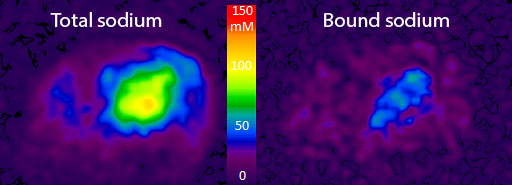 Figure: Quantitative sodium MRI images of a patient with brain tumor GBM at pre-treatment. Total sodium concentration image (left ) reflects sodium from both tumor and edema, while the bound sodium concentration image (right ) represents sodium from tumor itself (blue to green in color).
High Resolution Ultrashort Echo Time (UTE) MRI Technology
Qian's Lab for MRI at the General Labs Cloud, LLC announces a new technology that produces high resolution MRI images for the brain and knee at an ultrashort echo time (<1 ms). The high resolution UTE images can be used in clinical research to detect subclincal injuries/defects in cartilages of the knee or in parenchyma of the brain, without impact from edema fluids. The technology includes a pulse sequence and a computer program for image reconstruction. Data acquisition is based on an acquisition-weighted stack of spirals (AWSOS) pulse sequence, which is applicable to MRI systems at 3 Tesla or higher. This technology was invented by Dr. Qian and colleagues, patented in the United States (Patent No.: US7750632), and owned by the University of Pittsburgh, Pittsburgh, PA. Therefore, only lease is availabe to customers.


Figure (left): High-resolution UTE image of a healthy knee at 3T (TE = 0.6 ms, in-plane resolution = 0.14 mm, and slice thickness = 2.0 mm). Figure (right): High-resolution image of a healthy brain at 7T (TE = 1.1 ms, in-plane resolution = 0.22 mm, and slice thickness = 2.0 mm).
pM2: Parameter mapping of two-component exponential decays
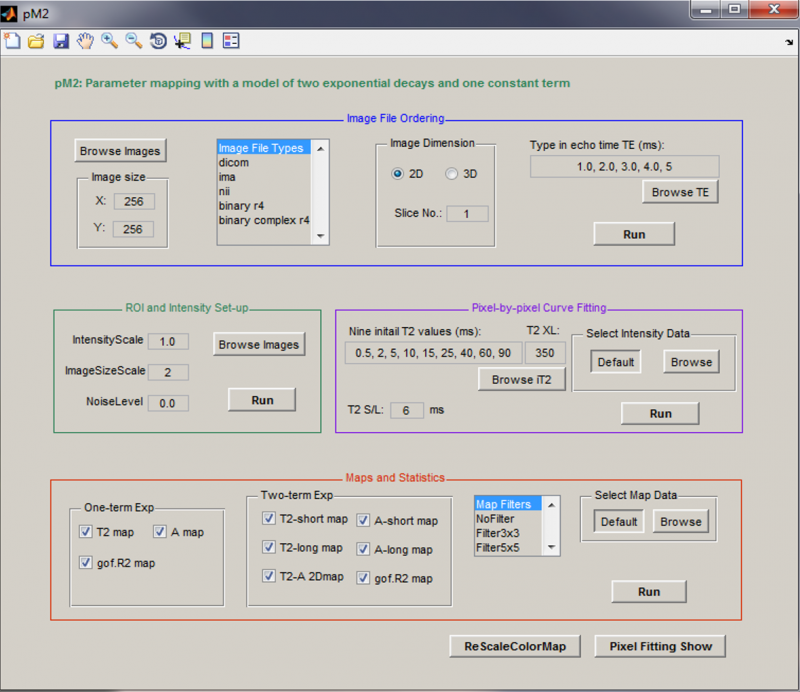 This software performs T2 and T2* mapping on MRI images at a pixel level, with a model of two component exponential decays plus a term of constant. The curve fitting at a pixel is based on an iterative NNLS-based algorithm. The software is a stand-alone MATLAB program and is applicable to PC/Mac computers without MATLAB installed in it. Purchase and lease of the softare are available to customers. This software is developed by the Qian's Lab for MRI. Figure: Panel of pM2.
pM1: Parameter mapping of one-component exponential decay
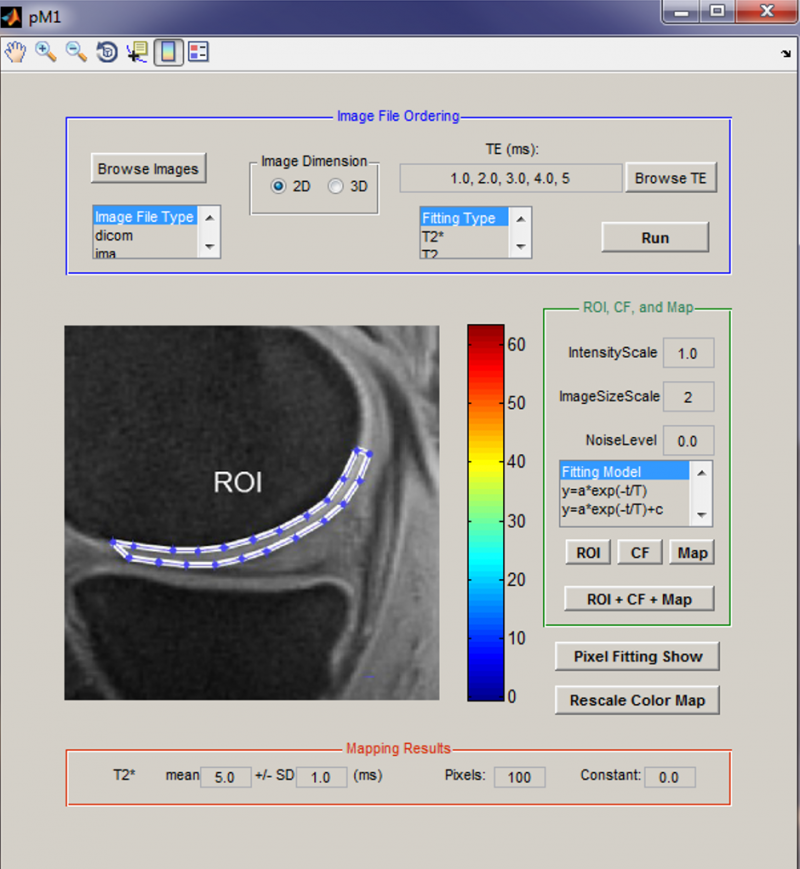 This software performs T2, T2*, T1, and T1rho mapping on MRI images at a pixel level, with a model of one component exponential decay plus a term of constant. The cure fitting at a pixel is based on exponential function exp1 in MATLAB. The software is a stand-alone MATLAB program and is applicable to PC/Mac computers without MATLAB installed in it. Purchase and lease of the software are available to customers. This software is developed by the Qian's Lab for MRI. Figure: Panel of pM1.
rgMC: rigid-body Motion Correction between MRI images in parameter (T1, T2) mapping
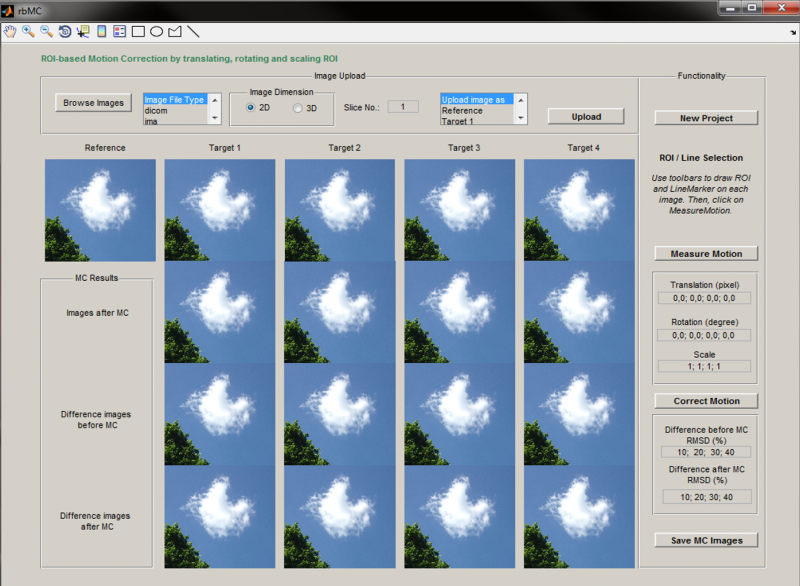 This software performs motion correction between MRI images for parameter (T1 and T2) mapping. It is based on the rigid-body model to calculate the motion of a region of interest (ROI) in translation, rotation and scaling, between the image and a reference image. Then, it corrects these motions for the image. The software is a stand-alone MATLAB program and is applicable to PC/Mac computers without MATLAB installed in it. Purchase and lease of the software are available to customers. This software is developed by the Qian's Lab for MRI. Figure: Panel of rgMC.
Pittsburgh, PA
info